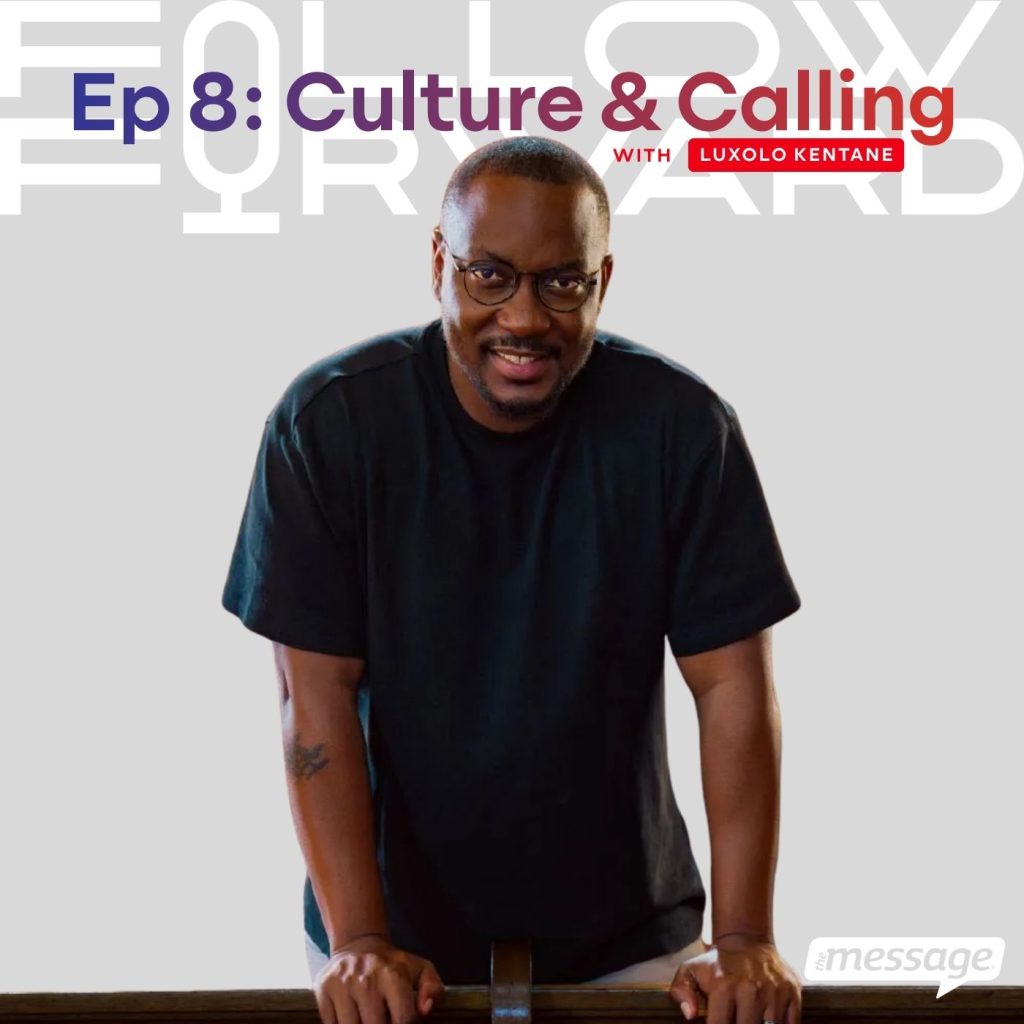
Follow Forward in Your Context
Adapted from a conversation with South African singer/songwriter Luxolo Kentane on the Follow Forward Podcast.*
If leadership really begins with followership, then there is an important component of leadership development that we should not neglect: God forms us first in our everyday context — long before we ever step onto a platform or into a boardroom. Luxolo Kentane is a South African creative evangelist whose story powerfully illustrates what it means to follow Jesus faithfully in the middle of real culture, real questions, and real life.
An Eastern Cape Story — and a Private Awakening
Luxolo grew up in a ministry‑immersed home, moving between evangelistic crusades across the Eastern Cape. Yet, beneath the noise of revival culture, he carried deep questions about relevance and reality.
As he put it:
“I had this on‑and‑off relationship with Christ… it always felt like there was a disconnect. I’d seen faith in my parents, but it never felt like it made any sense or relevance to me.”
Church was loud and energetic, yet far from the questions his peers were actually asking. So he developed a dual life — a church persona on Sundays, and a curious, culturally engaged teenager the rest of the week.
His turning point was not dramatic. He didn’t surrender at an altar call, but through the quiet personal engagement of a friend.
“I don’t think he preached to me… he just spent time with me. Actually, seeing Christ in him compelled me to ask the relevant questions.”
One Thursday night, alone in his room, Luxolo prayed his first sincere prayer — a quiet surrender that reshaped his story.
A Gospel That Speaks the Language of Culture
As his faith deepened, Luxolo began to wrestle with the divide between what the Church celebrated and what young people were drawn to. Hip hop wasn’t welcomed in many ‘religious’ spaces, but it was the heartbeat of the streets.
So he made a decision:
“I’m going to tell the story of Jesus in a way this culture understands — even if the church doesn’t understand it.”
When church leaders pushed back, he didn’t try to force his view. Rather, he simply moved outside the church to reach those he could relate to.
Youth groups, taxi ranks, street corners, late-night conversations — anywhere young people gathered, Luxolo carried the story of Jesus in their own language. He didn’t dilute the message; he translated it.
Choosing Unity Over Cynicism
Given his early experiences of being misunderstood, it would have been easy to grow sceptical about the Church. But instead, Luxolo took the long road toward unity.
“My posture should always be that we are there to serve the church… because once we start working together, there’s so much more we can do.”
Today, serving with Alpha Southern Africa, he is more committed than ever to strengthening the Church’s ability to engage culture with clarity and compassion.
Leadership Requires Proximity, Not Popularity
In an age shaped by digital influencers and visible platforms, Luxolo sees a deeper longing in young people:
“People follow leadership they can actually feel — leaders they can walk with.”
Luxolo’s example underlines that true influence isn’t about being widely seen; it’s about being genuinely present. True leadership isn’t built on reach but on relationship – not popularity but proximity. Authentic influence isn’t, therefore, about being widely seen. It’s about stepping into the cultural moment and embodying the presence of Christ there.
Investing in the Next Generation
Throughout our conversation, one thread kept emerging: legacy. As Luxolo put it:
“We should always be focusing on the next generation… taking ourselves out of our jobs as quickly as we can and raising up leaders.”
Our theology remains unchanging, but our methods must evolve if we hope to reach the future Church. For Luxolo, this means investing resources — time, energy, money — into those coming behind us:
Leadership is not about holding on to titles or positions. It’s about lifting others up so that they can surpass us.
Advice for Emerging Leaders
When I asked him what he’d say to young Christians stepping into their calling, Lucolo offered some straightforward wisdom:
“Put yourself around people who share the same passions and values. Ask: How can I help you? How can I serve you?”
Availability, curiosity, and teachability shape a lifetime of purpose.
In your everyday environment of work, neighbourhood, and culture, where might God be inviting you to make the gospel understandable?
Which of your current methods, assumptions, or habits need to shift to serve your context more faithfully?
As we follow Jesus in our own context, may His presence become visible through our lives, one relationship at a time.
*To find out more about the Follow Forward podcast, click here.
To listen to Jabulani’s interview, choose your preferred platform: YouTube, Apple, or Spotify.